The Droving Project launches spinning events

spinningThis November there is a great opportunity for people to try their hand at the traditional, functional and beautiful craft-forms of spinning and weaving as part of The Droving Project’s series of community events.

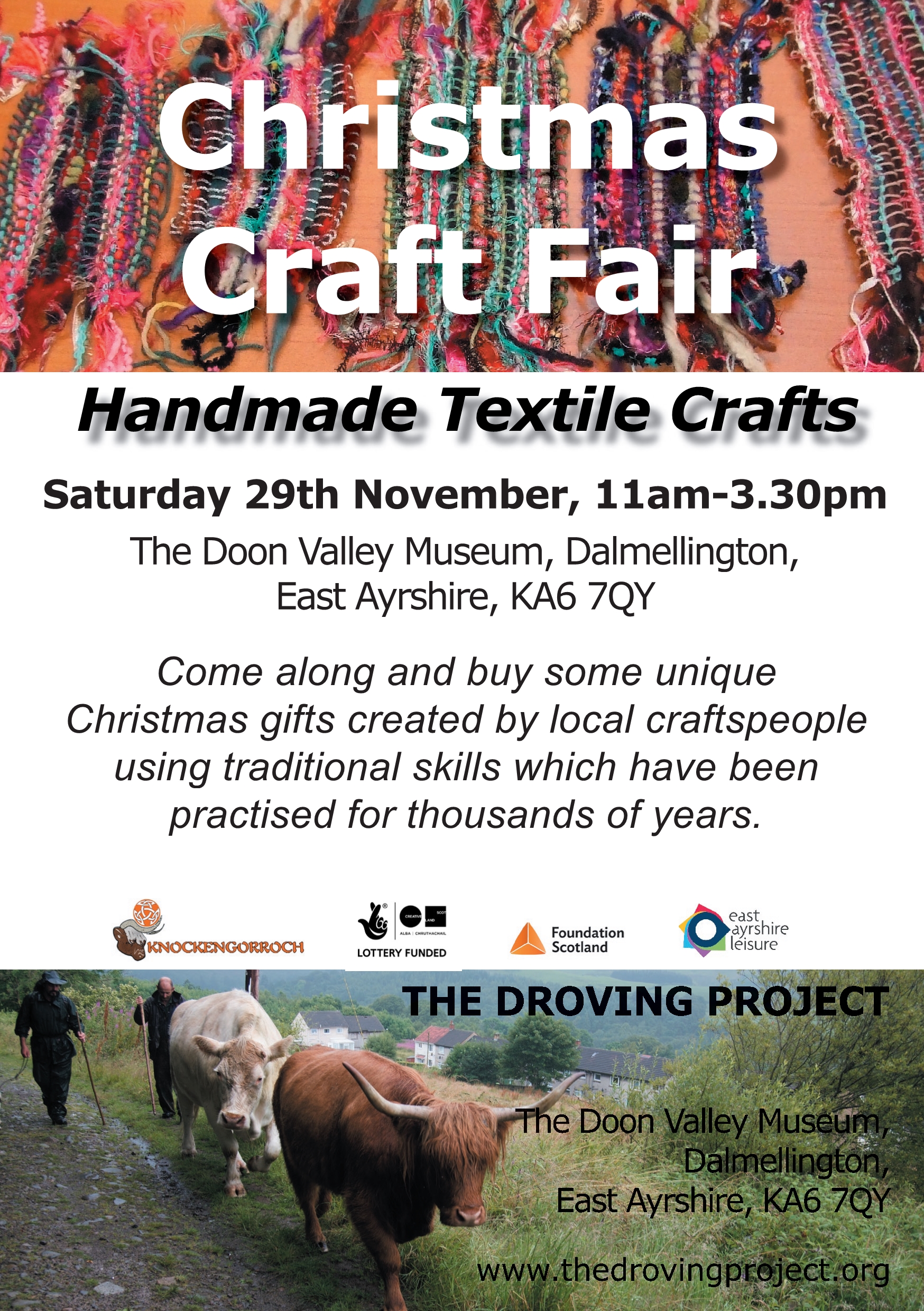
Free workshops by local artist Janet Renouf Miller and a demonstration by Ayrshire Handspinners will enable participants to make fabric from raw sheep’s wool, cow hair and various other materials.  There will also be opportunity to buy beautiful handmade textiles at the Christmas Craft fair on Saturday 29th November.

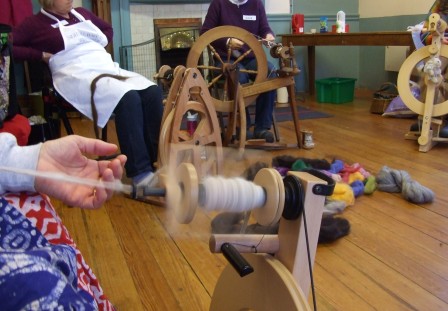
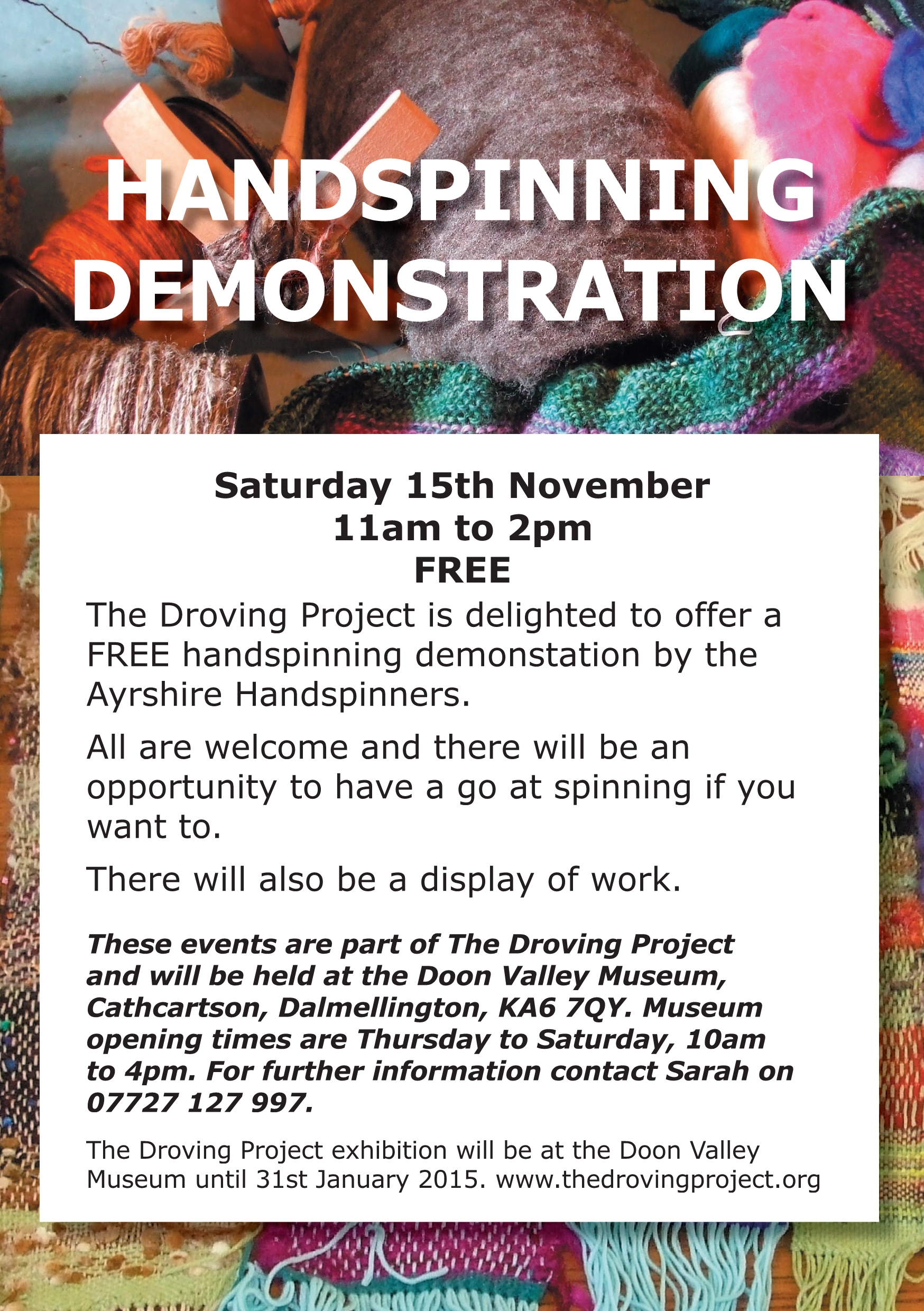
The workshops will start on Thursday 6th with an under 18’s weaving workshop, followed by an adults weaving workshop on Saturday 8 November and on Saturday 15th November there will be a spinning demonstration by the Ayrshire Handspinners.

These traditional rural crafts are enjoying a national resurgence, and seeing the process up-close will allow participants to get a real feel for these activities which may be done as a hobby or even to make a living, as there is more and more demand for real handmade fibre, fabric and clothing.

Janet Renouf Miller, who will tutor the workshops, says: “The Droving Project is an inspiring exhibition and I was delighted when Katch asked if I could provide workshops. In 2015 Ayrshire Handspinners will have been meeting in the Doon Valley Museum for twenty years, and it is very fitting that these workshops are taking place in what were once weaver’s cottages.”

These workshops and events are being run as part of The Droving Project, which also has an exhibition running at the Museum until 31st January 2015. The project involved photographing, filming and recording the sounds as cattle were walked along the old drove road from Knockengorroch to Bellsbank, and the resulting beautiful exhibition has captured the imagination of all who have visited. The Doon Valley Museum, Cathcartson, Dalmellington, is open 10am to 4pm from Thursdays to Saturdays.

The Droving Project’s producer, Katch Holmes, discusses the relevance of spinning and weaving to project in terms of pastoralism and traditional activities. She says:

The Droving Project has always been very much about place and history. Spinning and weaving are central activities to a pastoralist society and are still practised in South West Scotland today. We were delighted to receive funding from Foundation Scotland to allow us to offer the opportunity for people to try their hand at these crafts and for local practitioners to showcase their work, which safeguards a valuable part of our cultural heritage. Artist Janet Renouf Miller is experienced at teaching these ancient craft-forms and these workshops are really not to be missed!”

To find out more visit www.thedrovingproject.org , email thedrovingproject@yahoo.co.uk or ring 07727 127 997.

Under 18’s Weaving Workshop, Thursday 6th November, Doon Valley Museum, Dalmellington (contact Janet Renouf-Miller on 07712 575 874 for further info)

Weaving Workshop, Saturday 8th November, Doon Valley Museum, Dalmellington – FULLY BOOKED

Hand Spinning Demonstration, Saturday 15th November, 11am to 4pm, Doon Valley Museum, Dalmellington  (contact Janet Renouf-Miller on 07712 575 874 for further info)

Christmas Craft Fair, Saturday 29th November, 11am to 3.30pm, Doon Valley Museum, Dalmellington (contact Sarah Ade on 07727 127 997 for further info)
11

found scotEA leisure logo colour smallKnockengorrochlogo

Catrina Davies article on the Droving Project

Catrina Davies, writer, DJ and musician wrote a piece about the drove for Toast magazine.

THE DROVING PROJECT
3 September 2014
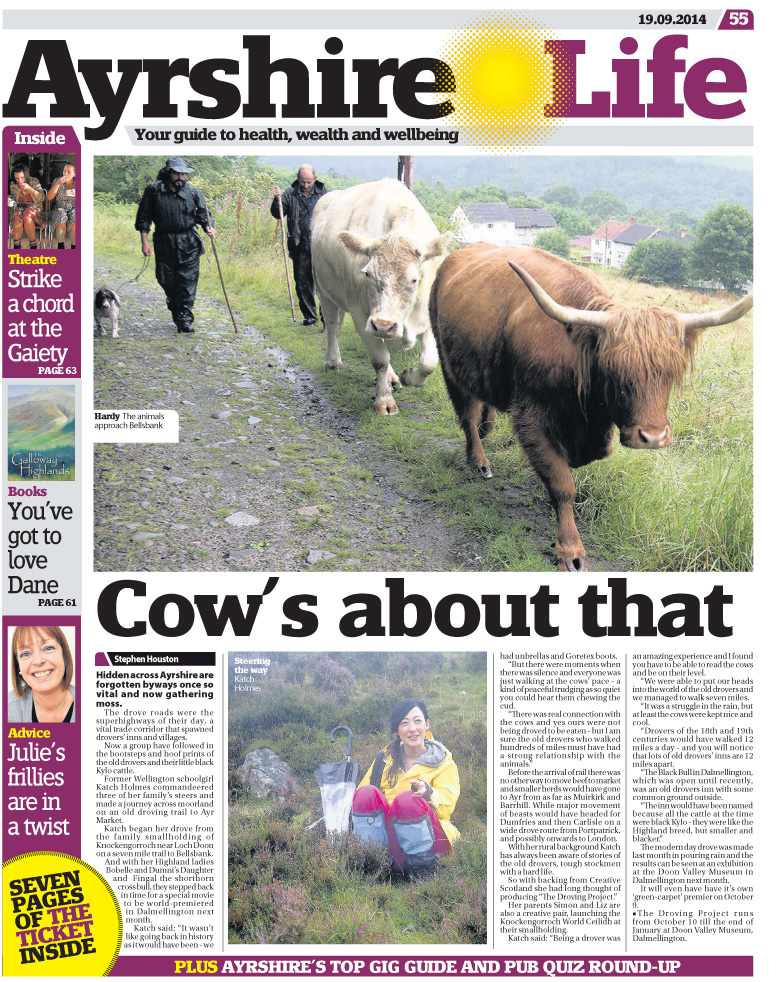
Catrina Davies drives cattle along an ancient drovers’ route in Scotland’s Southern Uplands as part of a project exploring the relationship between rural and urban culture

I have always liked cows. Happy cows seem to me the happiest animals on earth. In recent years I have taken myself on silent retreats, just to learn what cows already know: how to take my time, chew the cud, slow down.

It’s November. I’m in a pub in Hackney listening to my friend, Katch, talk about cows. She’s had an idea. She wants to drive a herd of cattle along an old drover’s route from Scotland to London. She wants to drive the cows into the centre of the capital. She wants people to stop what they are doing

and stare. She wants them to step in a steaming cowpat. She wants them to look at the cows and think about the burger they ate for lunch. She wants people to remember that they need the land and the fields. That cows matter. That rural culture literally feeds the cities. She wants to question the myth of progress handed down to the countryside by urban politics. She wants to hand something back.

Droving has a long history. Before the railways, cattle were herded on foot from the highlands to London, a journey that lasted months, employed hundreds and ensured cows arrived fat and happy to market. Walking with cows was part of our collective culture, embedded into our island psyche like cowboy culture is embedded into the psyche of North America.

Fast forward to August. I’m in the Southern Scottish Uplands, trudging through torrential rain with a fiddle player, a sound recordist, a filmmaker, a photographer, a botanist, two drovers, a vet, three cows and Katch. It’s a test run, tracing a seven-mile route from Katch’s family farm at Knockengorroch, in Dumfries and Galloway, to a village called Bellsbank which sits on the outskirts of an economically depressed ex-mining town in neighbouring Ayrshire.

Our ‘herd’ consists of two shaggy highlands (big horns, bigger hair) and a massive shorthorn cross, known as White Boy. They were all born at Knockengorroch, where Katch’s father has an old-fashioned

relationship with his animals. ‘He wants to die up on the hillside with the cows,’ says Katch.

Raised up over the sodden moorland, the ancient drover’s road is comparatively dry. There are small ditches each side and bridges over the worst of the bog. I’m told the green stuff under my feet isn’t grass but dozens of species of moss collectively known as sphagnum. Yesterday it was burnt yellow. Today it’s bright green. Heather, buttercups, willowherb and bog cotton are drinking like pissheads in a late-night bar. The hills and forests of Galloway are blurred, as if I’m looking at them through a

broken windscreen. Or that might be the rain in my eyes. We could use an ark.

It’s unclear whether the road we are following was built by drovers or Romans, but it is certain that drovers used it. It’s one of many such roads that criss-cross our nation. The cows move slowly, swinging their heads and looking at us, at each other, at the landscape. They munch and moo and flick their tails and shake their horns.

It’s a good thing the cows are moving slowly, since I am walking backwards holding an umbrella over Stevie’s camera, which he is pointing at their feet.

‘People used to walk at the same pace as their animals,’ he says, wiping his lens. It’s the sound-recordist’s turn. The rest of us hang back while he aims his microphone. Behind the sudden silence I can hear raindrops hitting the ground, the sound of water in the streams, the sound of cattle chewing. A snipe, easily mistaken for a didgeridoo. A lone beech tree bravely clinging to the side of a steep gulley.

We make our sodden way to Bellsbank, driving the cows along a track that passes a few feet from a large council estate. This is where the ex-miners live. I pick wild raspberries and watch the cattle move slowly past grey houses. There is a TV in a field. Or maybe it’s a bathtub. Empty lochs and hills stretch into the distance as far as the eye can see. A strange kind of disjunction. The people seem excluded from the land, herded into artificial enclosures, turned into spectators. There is plenty of parking.

But the old drovers’ routes remain. Old paths still link our old settlements and our old thoughts, connecting people and animals with their land and their past in a way that speed and ‘progress’ can never erase.

Photography by Alice Myers. An exhibition of Alice’s images documenting the drove took place on 9 October 2014 at the Doon Valley Museum in Dalmellington.

Catrina Davies is the author of The Ribbons are for Fearlessness and its accompanying Ribbons EP

Route update

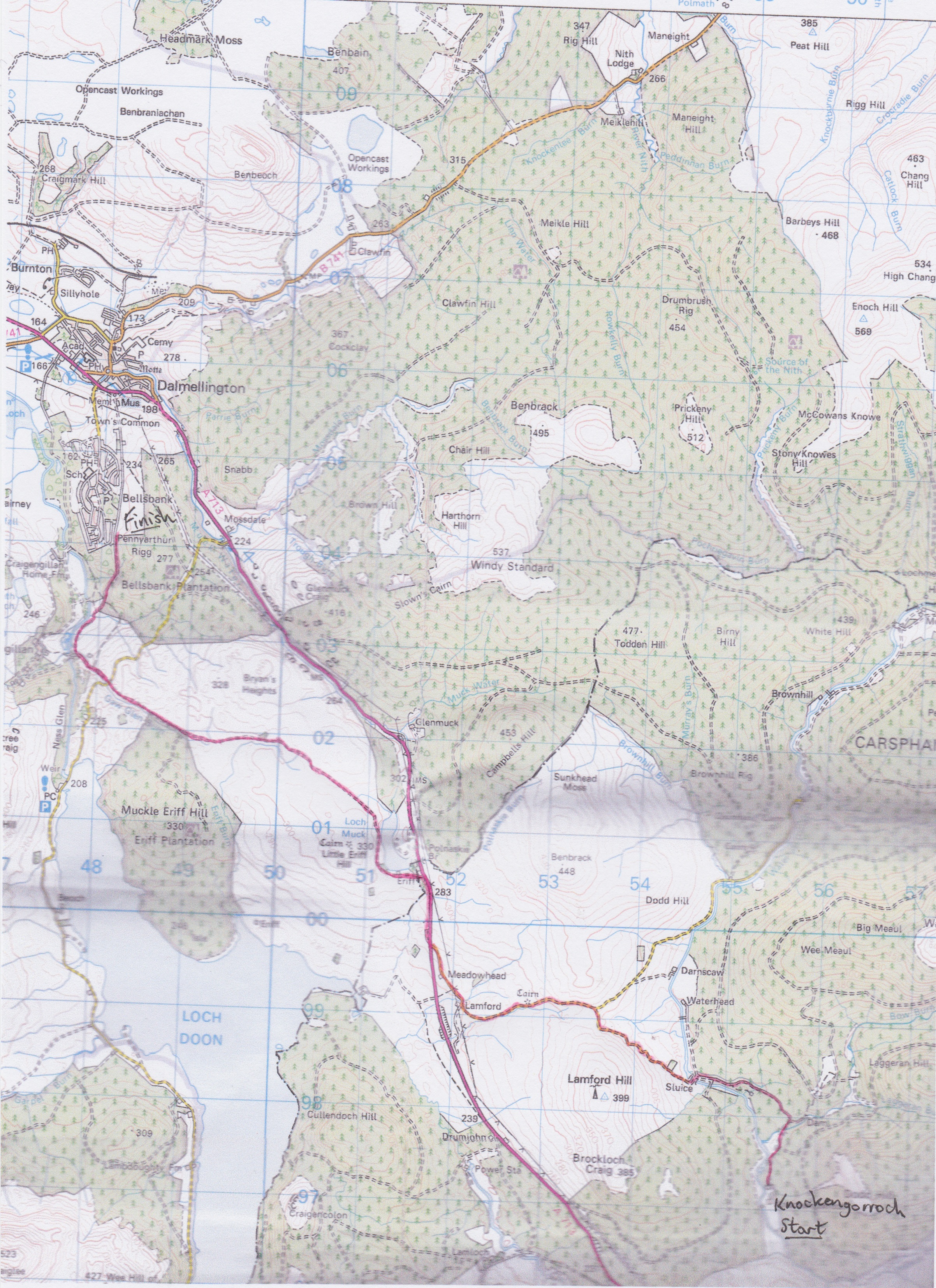
This is a map of the route we hope to take, which crosses 4 separate farms.  The whole route is grazed by sheep but not cattle.

Drove road scan

It has become clear that, due to the restrictions around moving cattle which involve a complete standstill of farms that they pass through for 13 days, it would take us 6 weeks or longer to travel the 7 miles or so out from Knockengorroch to Bellsbank.

If the cattle enter another farm both they and all the animals on that farm must stay put for 13 days.  Obviously if we were to observe this rule (even if the farmers were able to keep their animals on lock down for that long) the seven mile journey would take us 6 weeks!

An alternative would be to treat each piece of ground we move onto as a show ground, which means it needs to be cleared of all animals for 28 days beforehand.  As these pieces of land are large sections of moorland or hillside grazed by sheep it is not possible to clear all the animals off for 28 days.

As a result we will not be able to walk the whole route unbroken with the cows and will have to use a cattle truck to ferry them over all farms but one. (Thanks to WH McWilliam Cattle Haulage, Alexander Moffat and Davy Macmillan at Eriff farm for their help in this.)

To walk cattle across the land in this day and age, is not possible without a series of restrictions around clearing the land that is impossible for upland sheep farmers to observe.  The UK has some of the strictest restrictions around animal movements in the world.